Timeline
The Indus Valley Civilization: India’s First Urban Society
Introduction
Ancient Indian history ka sabse important chapter Indus Valley Civilization (IVC) hai. Ye civilization duniya ki earliest urban civilizations me se ek thi, jiska development planned cities, advanced drainage system, aur organized social life se hota hai. Isse Harappan Civilization bhi kaha jata hai.
Timeline
- Period: c. 2600 BCE – 1900 BCE
- Region: Present-day India aur Pakistan (Punjab, Sindh, Gujarat, Haryana)
Major Cities
- Harappa (Punjab)
- Mohenjo-daro (Sindh)
- Dholavira (Gujarat)
- Lothal (Gujarat)
- Kalibangan (Rajasthan)
In cities ka layout grid pattern me tha, jo advanced town planning ko show karta hai.
Town Planning & Drainage System
Indus cities ki sabse unique feature:
- Well-planned streets
- Baked brick houses
- Covered drainage system
- Public baths (Great Bath – Mohenjo-daro)
Ye system us time ke liye world ke sabse advanced systems me se ek tha.
Economic Life
- Agriculture: Wheat, barley, cotton
- Trade: Beads, seals, pottery ka trade Mesopotamia tak hota tha
- Dockyard: Lothal me world ka one of the earliest dockyards mila hai
Social & Cultural Life
- Standardized weights & measures
- Seals with animal figures (bull, unicorn, etc.)
- No clear evidence of kings or large palaces
- Society comparatively egalitarian lagti hai
Religion & Beliefs
- Mother Goddess worship ke evidence
- Pashupati Seal (proto-Shiva figure)
- Sacred trees aur animals ka importance
Decline of the Civilization
Exact reason clear nahi hai, lekin possible causes:
- Climate change
- River shifting
- Decline in trade
- Gradual urban decay (not sudden destruction)
Historical Importance
Indus Valley Civilization ne:
- Urban planning ki foundation rakhi
- Indian subcontinent me organized life ka start kiya
- Future Indian cultures par deep influence chhoda
Conclusion
Indus Valley Civilization sirf ek ancient society nahi thi, balki ek highly developed urban culture thi jo apne time se kaafi aage thi. Iski legacy aaj bhi Indian history ka ek strong pillar hai.
Prehistoric India: The Stone Age (Paleolithic to Neolithic)
Introduction
History is divided into three parts: Pre-history, Proto-history, and History. The phase we are starting today is Pre-historic India—a time when there were no written records, and human life depended entirely on nature and stone tools.
In India, the research on the Stone Age began when Robert Bruce Foote discovered the first Palaeolithic tool (a hand axe) at Pallavaram (near Chennai) in 1863.
The Stone Age is divided into three main periods based on the type of stone tools used:
1. Paleolithic Age (Old Stone Age)
- Timeline: Unknown to 10,000 BC.
- Lifestyle: Humans were hunters and food gatherers. They did not know agriculture or fire in the early stages.
- Tools: Large, rough, and unpolished stone tools (Hand axes, Cleavers).
- Key Sites:
- Bhimbetka (Madhya Pradesh): Famous for prehistoric rock paintings showing hunting scenes.
- Belan Valley (UP): Important for animal fossils.
- Soan Valley (Pakistan): Early stone tools found here.
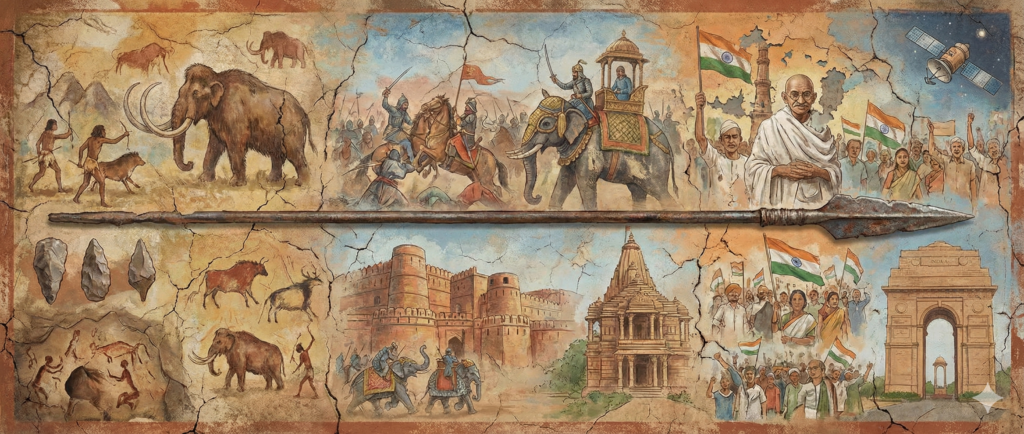
UPSC Fact: The Homo Sapiens (modern man) first appeared in the last phase of this age (Upper Paleolithic).
2. Mesolithic Age (Middle Stone Age)
- Timeline: 10,000 BC to 6,000 BC.
- The Transition: The climate became warmer, leading to better flora and fauna.
- Key Invention (Microliths): Humans started using very small, sharp stone tools called Microliths (1-8 cm), often attached to wood or bone to make arrows or spears.
- First Domestication: Evidence of animal domestication (livestock) is found in Adamgarh (MP) and Bagor (Rajasthan).
3. Neolithic Age (New Stone Age)
- Timeline: 6,000 BC to 1,000 BC.
- The Revolution: This phase marks the beginning of settled life. Man became a Food Producer (Agriculture) instead of a Food Gatherer.
- Inventions: The Wheel was invented, and pottery making started.
- Key Sites:
- Mehrgarh (Balochistan): Earliest evidence of agriculture (Wheat & Barley).
- Burzahom (Kashmir): Pit-dwelling houses (living underground) and dogs buried with masters.
- Koldihwa (UP): Earliest evidence of Rice cultivation.
Conclusion
The Stone Age laid the foundation for civilization. The transition from using raw stones to agriculture in the Neolithic age prepared the ground for India’s first urbanization—The Indus Valley Civilization, which we will cover in the next chapter.